Transition to a National Mandate
Mandatory Enforcement of Section ۱۹ from ۲۰۲۵: Green Building on the Verge of Transformation
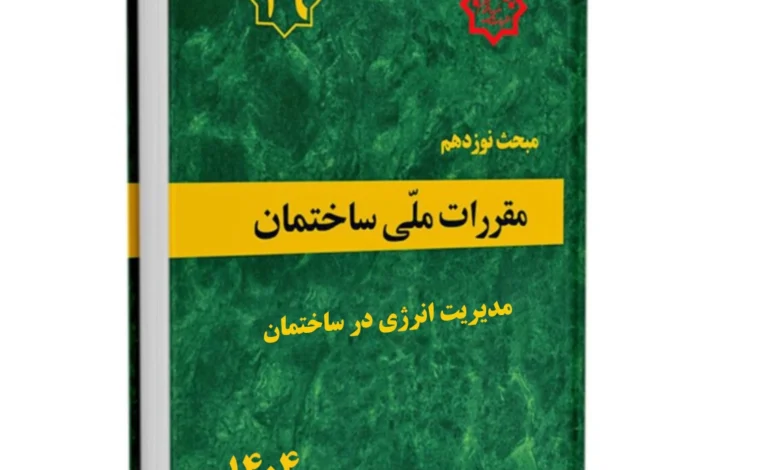
- Mandatory enforcement of Section 19 from March 2026; condition for building permits
- Projected 50% reduction in building energy consumption with implementation
- Fee discounts up to 30% for green buildings in Tehran
- Challenges in regulatory readiness and risk of fictitious approvals
With the deadline for mandatory enforcement of Section 19 of the Iranian National Building Regulations approaching, Iran’s construction industry is on the verge of a structural transformation—one whose success depends on the readiness of regulatory bodies, project economics, and engineering culture.
A Legal Framework Taking Shape
Green building in Iran has moved beyond slogans and general resolutions into the phase of defining executive frameworks. In Tehran, a Green Building Steering Committee has been formed with the participation of the Deputy Mayor for Urban Development and members of the City Council. Its main focus areas include developing assessment checklists, technical identification documents for buildings, and incentive and oversight mechanisms.
The key takeaway from these meetings is an effort to move from a limited program to a national approach in construction. The Deputy Mayor for Urban Development of Tehran has explicitly emphasized drafting a bylaw and presenting it to the government’s Infrastructure Committee. This signals that green building is transitioning from a local resolution to a national requirement.
Requirements Being Implemented
Meanwhile, the fifth edition of Section 19 of the National Building Regulations (Energy Conservation), officially announced in December 2024 (Dey 1404 in the Iranian calendar), is currently undergoing a transition period. The Minister of Roads and Urban Development recently extended the simultaneous implementation of the fourth and fifth editions until the end of the current Iranian year (March 2025) to facilitate executive processes and resolve operational challenges and ambiguities in the new edition.
What matters most, however, is the definitive end of this transition period in March 2026 (Esfand 1404). From the next Iranian year (starting March 2026), compliance with Section 19 will become a condition for issuing building permits. The East Azerbaijan Engineering Organization has also announced that it will become mandatory in building design from September 2025 (Mehr 1404).
Technical and Economic Dimensions
The building sector’s 40% share of national energy consumption is the primary driver of this transformation. With the implementation of Section 19 requirements, building energy consumption is projected to decrease by up to 50%.
The most significant feature of the new edition is its smart, control-oriented approach. Buildings must move toward energy management, meaning that through appropriate systems, energy consumption can be monitored and controlled. The concept of zero-energy buildings—which both consume and produce energy, feeding electricity back into the grid—is also emphasized in this edition.
At the national level, a memorandum of understanding has been signed between the Ministry of Roads and Urban Development, the Ministry of Energy, the Engineering Organization System, and Tavanir (Iran’s Power Generation, Transmission, and Distribution Management Company) to enhance energy efficiency and develop renewable energy in the building sector. This agreement focuses on improving efficiency, expanding solar systems, and reducing energy imbalance.
Incentives and Obstacles
To encourage developers, the Tehran City Council has approved fee discounts of up to 30% for buildings that meet green standards. These incentives are defined at three levels: compliance with more than 80%, 60–80%, and 50–60% of the standards.
Nevertheless, significant challenges lie ahead:
- Readiness of regulatory bodies: Municipalities and provincial engineering organizations lack full readiness in terms of specialized personnel and measurement equipment.
- Implementation costs: Increased construction costs under inflationary conditions pose a serious barrier for small and medium-sized developers.
- Risk of fictitious approvals: With expanded oversight, a new market for false certifications may emerge.
Analytical Table: Current Status of Green Building in Iran
| Aspect | Current Status | Outlook |
|---|---|---|
| Legal | Fifth edition announced; transition period until end of 1404 (March 2026) | Full mandate from 1405 (March 2026); condition for building permits |
| Institutional | Steering committee active in Tehran; national memorandum signed | Need for clear executive bylaw at national level |
| Technical | Emphasis on smart systems, monitoring, and energy control | Zero-energy and power-generating buildings |
| Economic | Fee incentives up to 30% | Need for bank facilities and tax exemptions |
| Executive | Engineer training initiated in provinces | Need to equip municipalities with measurement tools |
Likely Scenarios
Based on current trends, three scenarios are conceivable:
| Scenario | Probability | Key Indicators |
|---|---|---|
| Implementation failure | Medium | Extended transition period; lack of equipment in municipalities; developer protests |
| Symbolic implementation | High | Fictitious approvals; superficial oversight; no objective measurement of building performance |
| Real transformation | Medium | Banking and insurance sector support; training budget allocation; transparency in assessment processes |
Conclusion
Iran’s construction industry stands at the threshold of a paradigm shift. On one hand, legal, institutional, and technical tools are taking shape; on the other, traditional resistance, infrastructure gaps, and economic challenges make the path far from smooth.
Key point: The success of green building in Iran depends as much on the readiness of regulatory bodies, workforce training, and transparency in assessment processes as on the law itself.
The top-tier construction league has kicked off, but the teams and referees are still training. The outcome of the match will be clear by the end of 1404 (March 2026).